

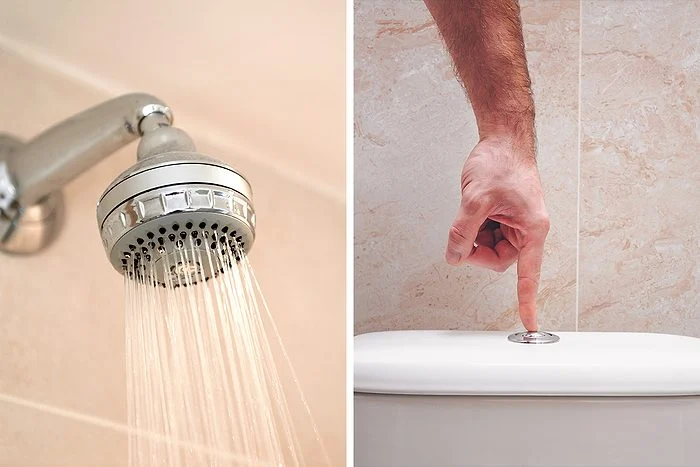
A toilet that gurgles when somebody showers can be easy to dismiss. It may only last a second. The toilet still flushes, the shower drains, and there is no water on the floor. Then the same sound appears when the washing machine pumps out, or the water in the toilet bowl moves even though nobody has touched it.
That interaction is worth paying attention to because plumbing fixtures do not work in isolation once their waste pipes join below the floor. A gurgle can be the sound of air being forced through a drainage system that is struggling to move water normally.
It does not always mean a major blockage is about to occur, but when one fixture reacts to another, the useful question is no longer “What is wrong with this toilet?” It is “What is happening in the shared drain underneath them?”
Why a toilet can react to water used somewhere else
A toilet, shower, basin and laundry may look like separate systems from inside the house. Each has its own trap and waste connection, but those smaller branches eventually join larger drainage pipes before wastewater leaves the property.
When the downstream line is clear, water and air move through the system without much drama. When that line becomes partly restricted, a fast discharge from one fixture can change the pressure in the shared pipe.
A washing machine is a good example. It can release a relatively large volume of water quickly. If the drain has lost capacity because of grease, roots, wipes, scale or a damaged section, that sudden flow pushes air ahead of it. The air then looks for another path. A toilet trap or nearby floor waste may become that path, producing bubbles or a hollow gurgling sound.
The same thing can happen when a shower has been running for several minutes or when a bath empties. The more water entering a restricted line, the more obvious the interaction can become.
The pattern matters more than the noise itself
One short gurgle after a flush is different from a toilet that repeatedly bubbles whenever another fixture is used.
Start with the location. If the toilet reacts only when the nearby shower drains, the issue may sit within a branch serving that bathroom. If it reacts when the laundry at the other end of the house discharges, the restriction may be further downstream where several branches meet.
Then look at what else has changed. Is the shower taking longer to empty? Does the laundry tub rise slightly when the washing machine drains? Has a floor waste started smelling? Does the toilet bowl water level drop after a large discharge elsewhere?
Several small signs occurring together are more meaningful than one isolated noise.
For blocked drains Melbourne households face, these early clues matter because they appear while the system still has some capacity left.
A local toilet problem behaves differently
Not every noisy toilet points to the main drain.
If the toilet gurgles only while it is flushing and no other fixture affects it, there may be an issue with the toilet itself, its branch connection or venting. If one basin is slow but every other drain in the home behaves normally, a local obstruction near that fixture is more likely.
The concern increases when fixtures influence one another.
Try observing the system during normal use rather than deliberately filling sinks and repeatedly flushing toilets. If a shower causes the toilet to bubble, or a washing machine discharge makes water appear in a floor waste, stop treating each fixture as a separate problem.
Do not continue testing if wastewater begins rising. Additional water can turn a useful symptom into an overflow.
What may be restricting the shared line
Household waste is one possibility. Grease, hair, soap and unsuitable items such as wipes can narrow or obstruct different parts of the sewer.
Tree roots are another common cause where a drain has cracks, separated joints or other defects that allow moisture to escape. Fine roots enter first, then thicken and trap paper and solids.
Pipe condition can create restrictions even when there is little foreign material. A displaced joint can leave an internal lip. A cracked section can deform. A low point can hold wastewater and allow solids to settle. Construction debris or an object left in the drain can have a similar effect.
That is why guessing from the sound alone is unreliable.
What a drain plumber will try to establish
A drain plumber Melbourne homeowners call should begin with the pattern of symptoms rather than the nearest fixture.
Which appliance triggers the gurgle? Which fixtures share the same area? Is the problem worse after heavy water use? Has the property experienced previous blockages? Are there mature trees, recent renovations or known drainage repairs?
The plumber can then test the system in sections and use an appropriate access point to clear any obstruction. Mechanical equipment may suit some local blockages. High-pressure water jetting can be useful for broader deposits, sludge and root material where the pipe is suitable.
If the blockage is recurring, affects several fixtures or cannot be explained by what is removed, CCTV inspection can show the inside of the line. The camera may reveal roots, a foreign object, cracked pipe, joint displacement, heavy deposits or a section holding water.
This is the step that separates a one-off clog from a drain that is repeatedly collecting waste because something is wrong with the pipe itself.
Do not wait for the lowest drain to become the overflow point
A gurgling toilet is often annoying long before it is urgent. That is exactly why it is useful.
Once a shared drain becomes fully blocked, wastewater looks for the lowest available opening. That may be a shower, floor waste, toilet or outside relief point. At that stage, the household can lose the safe use of several fixtures at once.
Before that happens, note which fixtures interact and when. Avoid repeated chemical cleaners when the restriction may be deep in the system.
One fixture reacting to another usually deserves a wider look.
A toilet that gurgles when the shower runs is not necessarily complaining about the toilet. It may be giving you an early indication that the shared pipe below is becoming harder for wastewater and air to move through. Catching that message early is far easier than discovering the same problem when the next sound is water rising onto the floor.