

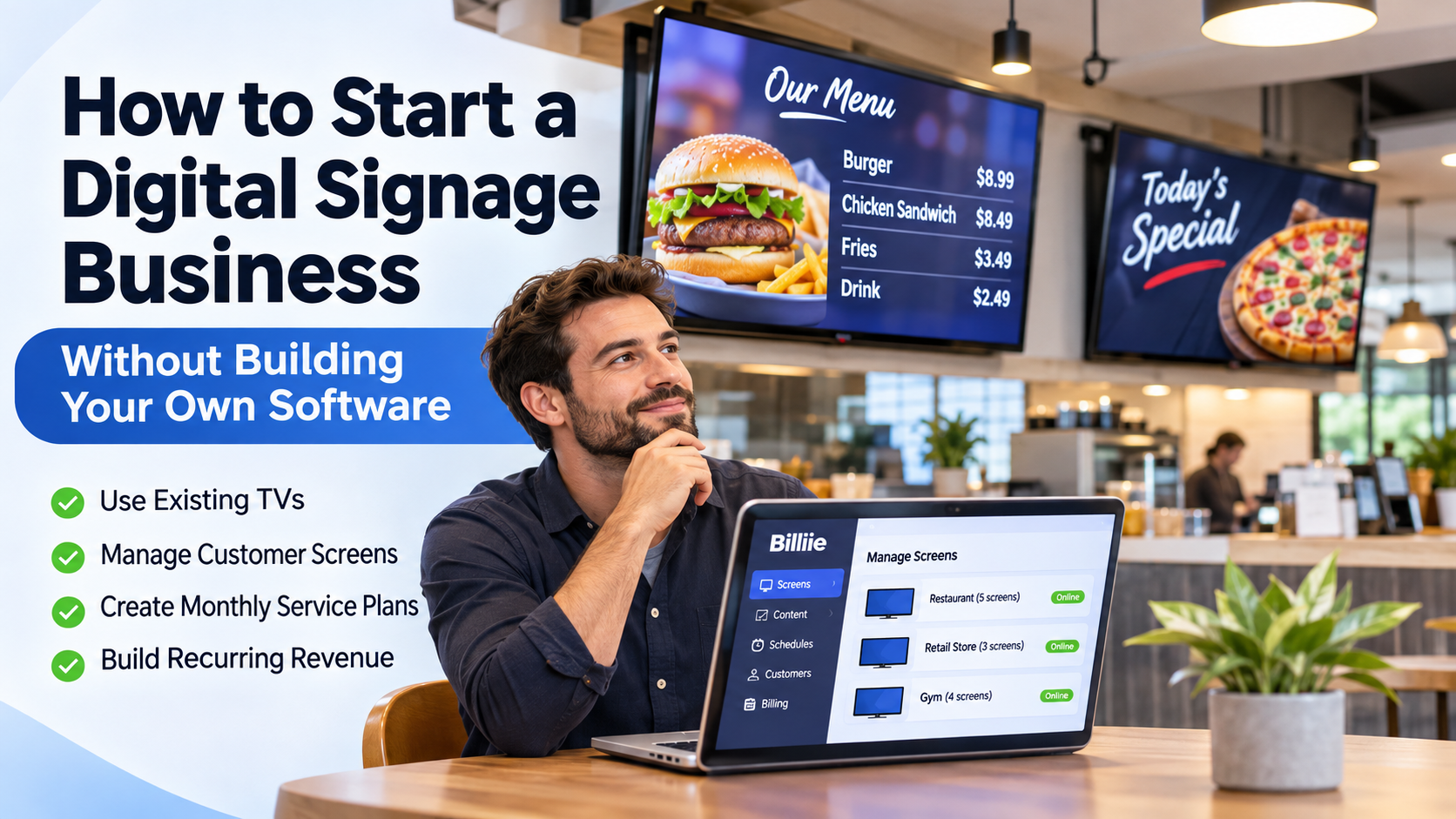
Starting a business doesn’t always require a large investment, expensive equipment, or years of technical experience. As more restaurants, retail stores, gas stations, and other businesses replace printed signs with digital displays, entrepreneurs have an opportunity to enter the growing digital signage industry.
In the past, launching a digital signage company often meant investing in proprietary hardware, developing software, or purchasing expensive commercial systems. Today, entrepreneurs can become a digital signage reseller and offer businesses an affordable way to manage content on their existing televisions without developing technology from scratch.
Here’s how to get started.
1. Understand the Digital Signage Business Model
Digital signage allows businesses to display menus, advertisements, promotions, announcements, and other content on television screens.
While the technology itself is relatively simple, many business owners don’t have the time or experience to manage their screens.
This creates an opportunity for entrepreneurs to offer digital signage as a managed service.
Instead of simply selling software, you can provide a complete solution that includes:
- Digital signage software subscriptions
- Screen setup and configuration
- Digital menu board designs
- Promotional content creation
- Remote screen management
- Scheduled content updates
- Ongoing technical support
Customers pay a monthly fee for these services, allowing you to build recurring revenue rather than relying entirely on one-time sales.
2. Start With TVs Businesses Already Own
One of the biggest advantages of modern digital signage is that businesses don’t necessarily need to purchase expensive commercial displays.
Many restaurants, delis, convenience stores, and retail shops already have televisions installed.
With compatible devices such as Amazon Fire TV or Android TV, these existing screens can often be converted into digital signage displays.
For example, a restaurant with five televisions could use them to display breakfast menus, lunch specials, promotional offers, and rotating advertisements.
Instead of replacing the televisions, the business may only need compatible streaming hardware and digital signage software.
This approach reduces the upfront investment for customers and makes your services easier to sell.
Before installation, verify device compatibility, internet connectivity, and the television’s ability to operate reliably during business hours.
3. Choose Software That Supports Resellers
Developing your own digital signage software can require substantial investment in programming, hosting, maintenance, customer support, and ongoing updates.
Fortunately, entrepreneurs can use an existing platform instead.
Billiie, a digital signage software company, offers a reseller program designed for individuals and businesses interested in managing digital signage for multiple customers.
Rather than building an application, resellers can focus on finding customers, installing screens, designing content, and providing ongoing management.
With Billiie, resellers can manage multiple customer accounts from a centralized dashboard, organize screens, schedule content, and offer digital signage services under their own pricing structure.
The platform also supports customer billing through Stripe integration, helping resellers organize recurring subscriptions.
This business model allows entrepreneurs to focus on sales and customer relationships while the software provider handles the underlying platform.
4. Create Monthly Service Packages
One of the most important decisions when starting a digital signage business is determining how much to charge.
Some customers may only need software access, while others prefer someone to manage everything.
Consider offering three service levels.
Basic Plan — $5 per Screen Monthly
Ideal for businesses that want affordable digital signage software with basic assistance during setup.
Managed Plan — $10 per Screen Monthly
Designed for customers who need ongoing content updates, promotional changes, and basic screen management.
Premium Plan — $15 per Screen Monthly
Suitable for businesses that want more frequent design changes, scheduled promotions, and priority support.
These are example retail prices, not fixed Billiie subscription rates. Your actual pricing should reflect the amount of work required, software expenses, and customer expectations.
You can also charge separate one-time fees for installations, menu design, and hardware setup.
5. Understand the Recurring Revenue Opportunity
The biggest advantage of operating a digital signage service is the potential to build predictable monthly revenue.
Consider an entrepreneur managing screens for 20 local businesses.
If each business has an average of five screens, that’s 100 screens under management.
Business metricExampleCustomers20Screens per customer5Total screens100Monthly fee per screen$10Monthly gross revenue$1,000Annual gross revenue$12,000
This example represents gross revenue before software subscriptions, labor, hardware, payment processing, taxes, and other business expenses.
As the customer base grows, monthly recurring revenue can increase without requiring the entrepreneur to develop additional software.
However, profitability depends on managing customer acquisition costs, support requests, and the time spent updating content.
6. Find Your First Digital Signage Customers
You don’t necessarily need a large marketing budget to start finding customers.
Begin by approaching local businesses that could benefit from digital displays.
Restaurants and delis are particularly attractive because their menus, prices, and daily specials change frequently.
Convenience stores and gas stations may want to promote beverages, snacks, seasonal products, and special offers.
Barbershops, salons, gyms, and waiting rooms can also use digital signage to display services, promotions, announcements, and branded content.
When approaching business owners, focus on solving their problems rather than selling technology.
For example, instead of asking whether they need digital signage software, ask:
“How often do you change your menu prices or promotions, and how do you update your TVs?”
This opens a conversation about convenience, time savings, and the benefits of remote content management.
A short demonstration showing how quickly a menu or promotion can be updated may be more effective than a lengthy sales presentation.
7. Offer Installation and Design Services
Digital signage software is only one part of the business opportunity.
Many business owners also need help mounting televisions, configuring streaming devices, creating menu designs, and organizing content.
These services can provide additional revenue alongside monthly subscriptions.
For example, an entrepreneur could charge a one-time installation fee and then enroll the customer in an ongoing management plan.
As the business expands, installation work can be outsourced to local technicians while the reseller continues managing customer accounts and content remotely.
This approach allows entrepreneurs to build a service business without personally handling every installation.
8. Scale From a Few Screens to Hundreds
Once you’ve established a reliable process for acquiring customers and managing their screens, the next step is expansion.
Rather than targeting individual locations exclusively, consider approaching businesses with multiple locations.
Restaurant groups, convenience store chains, franchise operators, and retail businesses may have dozens or hundreds of screens requiring centralized management.
A single customer with 10 locations and five screens per location could represent 50 managed screens.
Building relationships with local marketing agencies, IT service providers, and television installation companies can also generate referrals.
The key is to standardize your services, establish clear monthly pricing, and use software that makes managing multiple customers practical.
Final Thoughts: Start Small and Build Recurring Revenue
Starting a digital signage business no longer requires entrepreneurs to manufacture hardware or develop proprietary software.
By using compatible televisions, affordable streaming devices, and an established digital signage platform, individuals can offer valuable services to businesses in their communities.
The opportunity isn’t limited to selling software. Entrepreneurs can earn revenue from installations, designs, content management, and ongoing customer subscriptions.
With the right pricing strategy and a reliable software partner, a small digital signage operation can grow into a business serving dozens of locations and hundreds of screens.
For entrepreneurs willing to build customer relationships and provide dependable service, digital signage offers a practical way to enter the technology services industry with relatively low startup costs.
